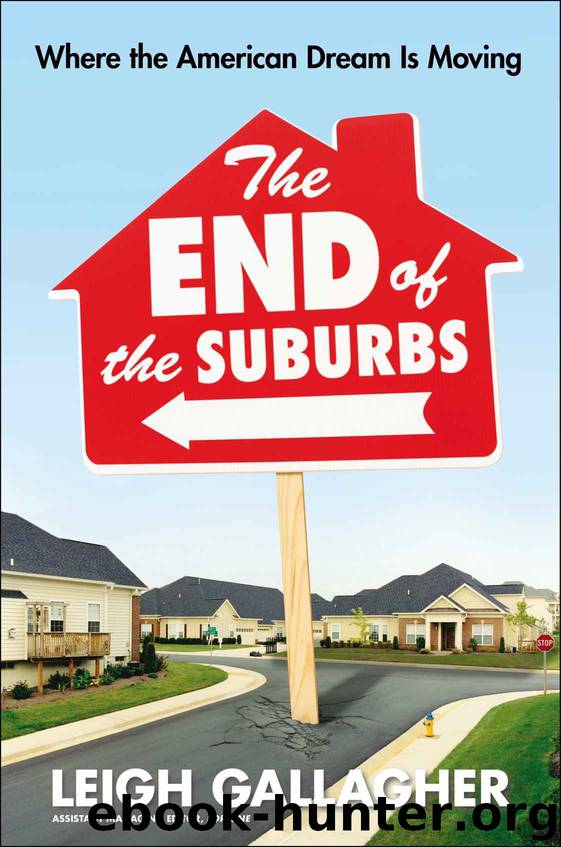
The End of the Suburbs: Where the American Dream Is Moving by Leigh Gallagher
Author:Leigh Gallagher [Gallagher, Leigh]
Language: eng
Format: epub, mobi
Tags: Non-Fiction, Sociology, Politics
ISBN: 9781591845256
Amazon: 1591845254
Goodreads: 15811507
Publisher: Portfolio Hardcover
Published: 2013-06-27T07:00:00+00:00
5
THE END OF THE NUCLEAR FAMILY
Monica: “We want a lawn and a swing set and a street where our kids can ride their bikes—”
Chandler, interrupting: “And maybe an ice cream truck will go by!”
Ross, deadpans: “So you want to buy a house in the 1950s.”
FRIENDS, SEASON 10, EPISODE 10, JANUARY 2004
No one knows when exactly Austintown, Ohio, got “old,” but for the people living there, there’s no denying it. Once the province of young families looking for safe streets and good schools, the population of this middle-class suburb outside Youngstown is now nearly 20 percent senior citizen. And the place is starting to show its age: the library has beefed up its large-print collection; Tuesday night concerts in Township Park feature big band, polka, and groups—Ginny and the Jettz, Sunshine Riders—named for heydays gone by; and like stray gray hairs, a Bob Evans, Perkins, and other franchise purveyors of soft foods and early bird specials have cropped up along the town’s main commercial strip. “Austintown used to be a party town,” says resident Jim Henshaw, age seventy. “We’ve all aged and matured a bit.”
Henshaw would know. A retired hospital executive, he’s now the executive director of Austintown’s senior center, which, since its founding in October 2010, has become the new hot spot in town. “Too many people were sitting around doing nothing,” says Gary Brant, an active eighty-year-old who moved with his wife, Myra, and two small children to Austintown fifty-two years ago for the schools. With their need for quality education long behind them, Brant still lives in the same house, and he has no plans to leave it. His friends are all there, his son is nearby, and besides, he’s having too much fun. At the senior center, he now calls $7 bingo games three times a week. “The only way I’m moving from this house is in a box,” he says.
Welcome to the retirement community of the twenty-first century: the cul-de-sac. Those now sixty-five and older were once the generation that fed the subdivision boom in the ’50s, ’60s, and ’70s. Now, due to a combination of factors including the housing crisis, longer life spans, and the simple desire to stay in the communities they’ve lived in for most of their lives, they’re staying put. At the same time, younger generations are having fewer children, sending ever more single-person and childless-couple households into the market.
The U.S. birth rate, which reached a high of 122.7 births per thousand people in 1957, has been dropping ever since, falling particularly sharply in the past few years. In 2011 it hit 63.2 per thousand people, a record low. Meanwhile, as the percent of children has been falling, the overall population is aging. The percent of people 65 and over hit a record 13 percent of the population in 2011. From 2000 to 2010, the ranks of Americans 45 and older grew eighteen times as fast as the population younger than 45, and the median age in the United States is currently 37.
Download
The End of the Suburbs: Where the American Dream Is Moving by Leigh Gallagher.mobi
This site does not store any files on its server. We only index and link to content provided by other sites. Please contact the content providers to delete copyright contents if any and email us, we'll remove relevant links or contents immediately.
| Anthropology | Archaeology |
| Philosophy | Politics & Government |
| Social Sciences | Sociology |
| Women's Studies |
Nudge - Improving Decisions about Health, Wealth, and Happiness by Thaler Sunstein(7706)
The Fire Next Time by James Baldwin(5442)
iGen by Jean M. Twenge(5415)
Adulting by Kelly Williams Brown(4574)
The Sports Rules Book by Human Kinetics(4386)
The Hacking of the American Mind by Robert H. Lustig(4382)
The Ethical Slut by Janet W. Hardy(4251)
Captivate by Vanessa Van Edwards(3839)
Mummy Knew by Lisa James(3691)
In a Sunburned Country by Bill Bryson(3542)
The Worm at the Core by Sheldon Solomon(3487)
Ants Among Elephants by Sujatha Gidla(3467)
The 48 laws of power by Robert Greene & Joost Elffers(3291)
Suicide: A Study in Sociology by Emile Durkheim(3022)
The Slow Fix: Solve Problems, Work Smarter, and Live Better In a World Addicted to Speed by Carl Honore(3009)
The Tipping Point by Malcolm Gladwell(2921)
Humans of New York by Brandon Stanton(2873)
Get What's Yours for Medicare: Maximize Your Coverage, Minimize Your Costs by Philip Moeller(2728)
Handbook of Forensic Sociology and Psychology by Stephen J. Morewitz & Mark L. Goldstein(2705)
